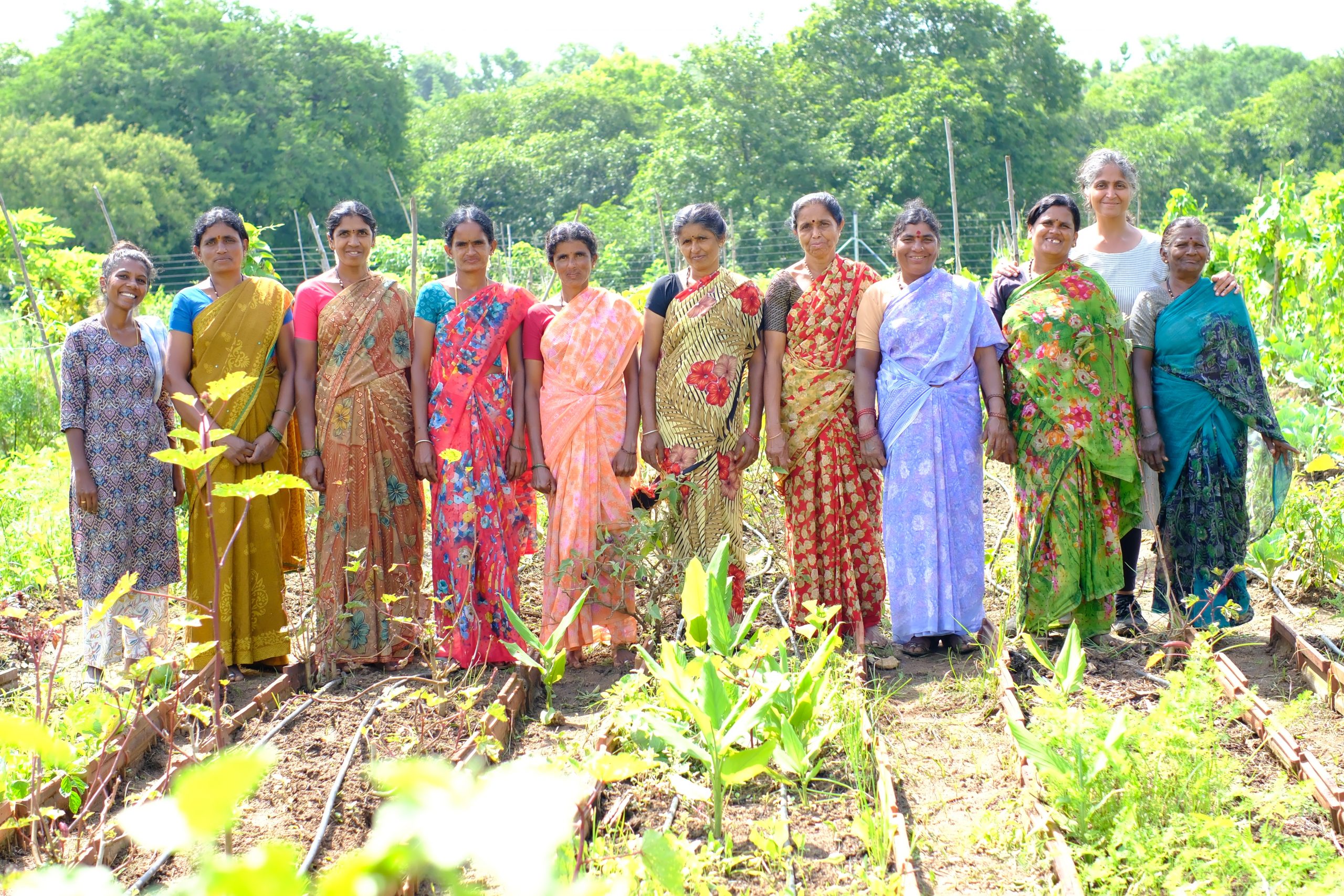
Organising a collective begins with people coming together. What matters most is not the form—whether it’s a savings group or simply neighbours—but the trust, shared values, and willingness to work side by side.
Once that spirit is in place, everything else can follow: how you organise yourselves, how you share work, and how you seek support.
01. Who Can Form a Kai Thota Collective?
A Kai Thota collective can begin with existing Self-Help Groups (SHGs). Groups that already meet regularly and are built on trust, savings, and shared responsibility—making them a natural starting point for farming.
But it doesn’t have to be an SHG. Any group that meets regularly with a shared purpose can become a farming collective:
- Mahila Mandals or Kisan groups
- A temple, church, or mosque congregation
- A water user group
- A local youth club
Even a neighbourhood WhatsApp group
What matters most is that people meet, talk, trust one another, and share common values—especially around working together, sharing labour, and respecting the land.
| 💡 Tip |
| If your group isn’t already formal, you can register it later as a joint Self-Help Group (SHG), a Farmer Interest Group (FIG), a Mutual Benefit Society, or a Cooperative. You could also just simply maintain a record of names, meetings and decisions. For many schemes, even this informal structure is enough to begin. |
02. What are Some Ways You Might Work Together?
Once your group is formed, it’s important to agree on how decisions will be made and how responsibilities will be shared. This helps avoid confusion later and gives everyone a sense of ownership and clarity.
Many Kai Thota groups follow simple practices inspired by SHGs:
- Rotational leadership – Change roles every 3 to 6 months so that everyone learns and no one feels overburdened.
- Basic bookkeeping – Use a ruled notebook or passbook to track income, expenses, meetings, and harvests.
- Regular meetings – Meet weekly or every 15 days to plan work, solve problems, and review progress.
Key Roles of the Group Leader
- Helps guide the group and calls for meetings.
- Tracks income, expenses, subscriber lists, and minutes of group discussions.
- Communicates with the Panchayat, officials, or NGOs on behalf of the group.
- Plans daily or weekly farm activities and makes sure work is divided fairly.
| 💡 Tip |
| You don’t need formal elections. Start with who’s comfortable, then rotate every few months. |
03. What might be important to talk
about early on?
Before starting farming as a collective, it’s important to sit together and discuss key topics. These conversations help everyone understand their role, avoid confusion later, and ensure the group works fairly and smoothly.:
- What to grow? And where?
- Decide together which crops, vegetables, or plants you want to grow.
- Look at the land and think about sunlight, soil, and water availability.
- How will produce or profits be shared?
- Agree on a fair way to divide vegetables, fruits, or money from sales.
- All members should share the produce and profits equally, regardless of their role or position in the group.
- What if someone misses farm work regularly?
- Discuss rules for attendance and participation.
- Decide how to support members who cannot come regularly due to work, health, or family duties.
- How will we include members who can’t read, write, or speak confidently?
- Some members may not read, write, or speak confidently. Plan ways to include everyone in decisions and farm work.
- Show how it’s done, explain it, and repeat instructions so everyone can learn by doing.
- Pair less confident members with others for guidance and support.
- Other conversations to have-
- How to handle disputes or disagreements in the group.
- Safety measures on the farm (tools, water, etc.)
- Scheduling weekly or bi-weekly meetings to plan, review, and celebrate progress.
Inclusion is important. Design your group in a way where everyone can participate—no matter their background, education, or confidence level.
04. How Can the Panchayat Support You?
Your Gram Panchayat is an important supporter. Many collectives succeed because they engage early and consistently with local governance. Your Panchayat can –
- Help you identify unused commons or public land
- Approve small infrastructure works (like a compost pit, fencing, or bunds)
- Recommend you for government schemes
- Support you in applying for schemes or subsidies and also support large cluster development in case your group is eligible
- Connect you to horticulture officers for saplings or compost from the State Rural Livelihoods Mission (SRLM) or National Rural Livelihoods Mission (NRLM)
How to Approach Your Panchayat?
- Speak to the Panchayat members, Panchayat Development Officer (PDO)/Gram Panchayat Level Federation (GPLF) coordinators about your intentions and needs
- Attend Gram Sabhas & The Special Gram Sabhas (Jan 26, Aug 15, Oct 2) and present yourselves as a group
- Present a simple plan:
- Who you are
- Why you want to farm together
- What kind of land/support you need
- Ask for a letter of support, even if verbal permission is already given.
| 💡 Tip |
| The group leader and record keeper can keep a small folder with the following information and documents, especially when presenting yourself to the panchayat: 1. Group list (SHG or collective) 2. Aadhaar photocopies of members 3. A vert simple proposal in Kannada (2-3 paragraphs) 4. Photos of the group members 5. Bank account details (SHG or one lead member) 6. An previous training or scheme registration documents (if applicable) |
Resources:
Glossary:
Groups and Collectives-
- Self-Help Group
A small group of people, typically 10–20 members, who save money together, provide small loans to members, and support each other financially and socially. - Farmer Interest Group (FIG)
A group of farmers organised to collectively plan farming activities, share knowledge, and access resources or government schemes for agriculture. - Mutual Benefit Society
A legally registered organisation where members pool resources or funds for shared benefit, often for livelihood or community development. - Cooperative
A formally registered group where people work together for farming, marketing, or business, and share profits and responsibilities.
Government Programs and Missions-
- National Rural Livelihoods Mission (NRLM)
A national program that helps poor families in villages form SHGs, earn income, and get skill training. - State Rural Livelihoods Mission (SRLM)
The state-level program under NRLM that helps SHGs and farmer groups improve incomes and livelihoods.
Local Governance-
- Panchayat members
Elected members of the Gram Panchayat who make decisions and manage local village work. - Panchayat Development Officer (PDO)
A government officer who helps the Panchayat plan and run village programs. - Gram Panchayat Level Federation (GPLF
A group made by bringing together several SHGs in a village to coordinate, access schemes, and work collectively. - Gram Sabhas
A meeting of all adults in a village to discuss development, resources, and schemes are discussed and approved. - The Special Gram Sabhas
Gram Sabha meetings are held on national days such as 26 January, 15 August, and 2 October to discuss important village matters and present proposals for approval.